
Comet 3I/ATLAS, the third known interstellar object to enter our solar system, has recently exhibited some striking behavior and peculiar characteristics in new observational campaigns during 2025.
Jet Activity and Coma
Recent images captured in August and publicized in October 2025 show 3I/ATLAS blasting a dramatic jet of gas and dust toward the sun. As the comet nears the sun (perihelion is October 29, 2025), increased solar heating causes material from its icy surface to jet outward, forming a visible coma and pronounced tail. The jet was observed using the Two-meter Twin Telescope at Teide Observatory, combining 159 exposures and revealing a purplish burst aimed at the sun—typical for comets when they experience intense solar radiation.
Rotation and Activity Levels
Spectroscopic studies in July 2025 found a rotational period of about 16.16 hours for the nucleus of 3I/ATLAS, and photometric analysis showed that it sheds dust at rates from 0.3 to 4.2 kg/s—an unexpectedly high level for an interstellar comet. These rates and rotation characteristics suggest similarities to solar system comets, though their composition remains under further investigation.
Tail Behavior and Controversies
Images in September 2025 from the Nordic Optical Telescope revealed the comet had an unusual "anti-solar tail" (facing away from the sun), which then changed direction and transitioned into a normal tail in September. This unusual behavior has led to speculation and debate among some scientists about the comet's origins, with some suggesting highly controversial theories about possible non-natural or "controlled" movement, though most astronomers attribute this to natural dynamics.
Discovery and Trajectory
Comet 3I/ATLAS was discovered by the ATLAS telescope in Chile in July 2025, with earlier "pre-discovery" images extending back to mid-June. Its hyperbolic orbit proves its interstellar origin, and it will reach perihelion (closest approach to the sun) on October 29, coming as close as 1.4 astronomical units to the sun—inside Mars's orbit but never near enough to Earth to pose risk.
Summary Table
|
Observation |
Details |
|
Discovery |
July 2025 (ATLAS survey, Chile) |
|
Spin Period |
16.16 hours |
|
Perihelion Date |
Oct. 29, 2025 |
|
Closest to Earth |
1.8 AU (Oct. 30) |
|
Mass-Loss Rate |
0.3–4.2 kg/s |
|
Jet/Tail |
Jet and unusual tail observed |
|
Origin |
Interstellar (hyperbolic orbit) |
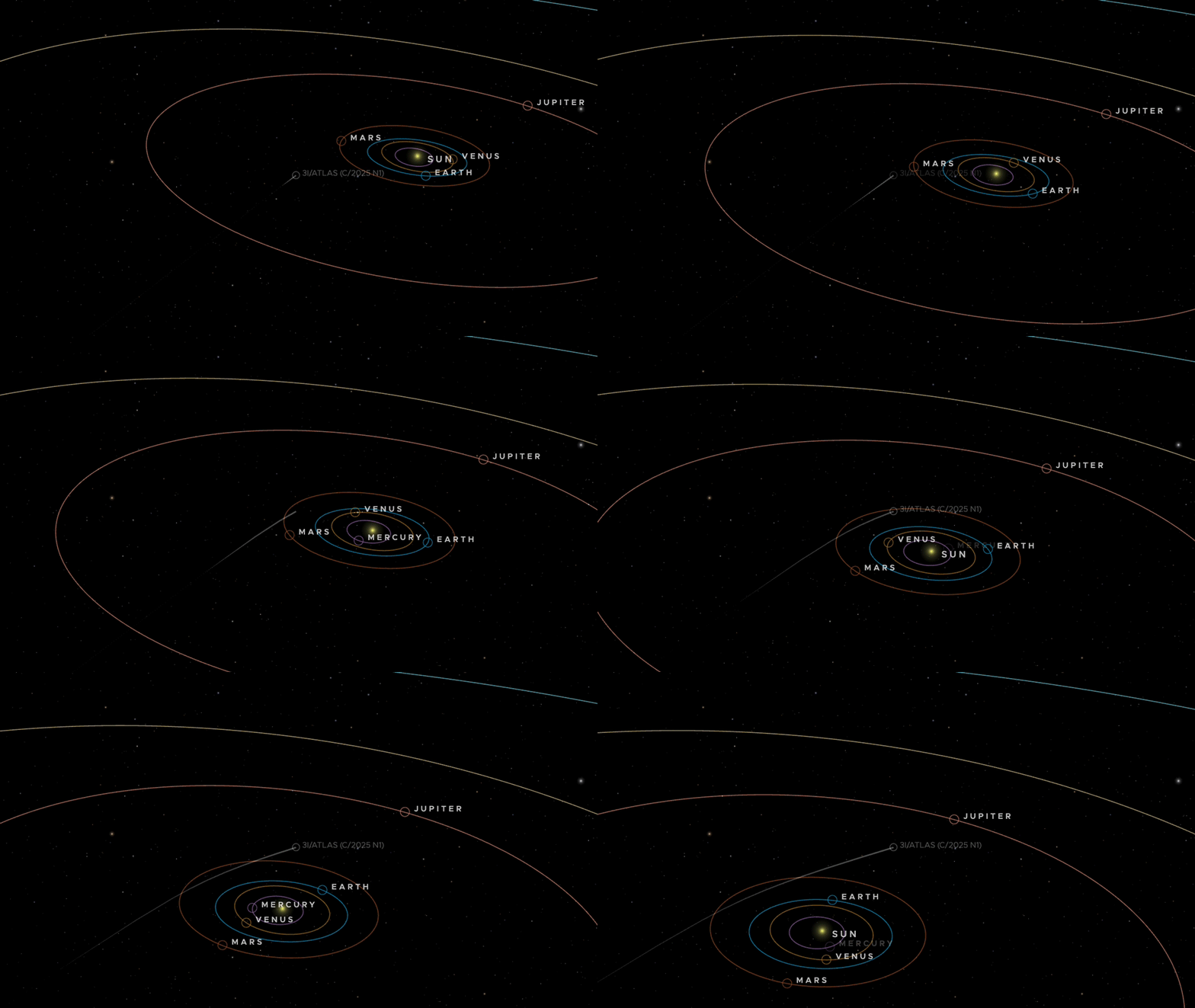
Comet 3I/ATLAS continues to challenge our understanding of interstellar objects, offering fresh insights and driving scientific debate as it nears its closest approach to the sun and prepares to leave the solar system.


No comments:
Post a Comment